
 Support
 Contact us

 English


 Back to lobby


Dr. Yakov Zhitomirsky Sep 10, 2026
From Technology Clutter to Clinical Clarity
A Framework for Navigating Technology Through Functional Purpose
The challenge of technology hypersaturation
Healthcare is entering an era of technology hypersaturation. New digital and AI-enabled solutions are appearing faster than clinical organizations can meaningfully absorb them: predictive models, AI copilots, ambient documentation, computer vision, intelligent monitoring, decision support, automation, and increasingly autonomous systems. In critical care, where digital complexity was already high, this acceleration is especially visible.
The challenge is no longer simply which technology should we adopt? It is also how to make sense of an increasingly crowded technology landscape, determine where different solutions fit, decide where limited resources and attention should go, understand overlaps and gaps, and ensure that technology ultimately serves meaningful clinical and operational needs.
The current wave of AI makes this particularly difficult. Almost every week brings a new capability, product, model, or category. The terminology evolves almost as rapidly as the technology itself. AI, generative AI, agents, copilots, ambient intelligence, computer vision, predictive analytics, and automation increasingly overlap. Organizing the landscape around those labels can therefore create as much cognitive clutter as clarity.
What healthcare organizations need is not another catalogue of technologies. They need a stable mental framework for making sense of them.
Start with the job
Instead of beginning with categories such as AI, computer vision, medical devices, or generative AI, begin with something more durable: the clinical or operational job that needs to be done.
Technology changes quickly. Clinical needs change much more slowly.
Clinicians will require a need to recognize deterioration earlier, make better decisions, optimize therapy, reduce avoidable harm, observe patients more effectively, spend less time documenting, use scarce resources wisely, and learn from accumulated clinical experience. The technologies used to accomplish those jobs may change dramatically, but the jobs themselves provide a much more stable reference point.
Applied consistently, this perspective organizes the technology landscape into the eight use-case categories described below.
Predict: Recognize adverse clinical events before they manifest, using real-time physiological data. What you gain is time: the gap between the first meaningful signal and the point where intervention becomes urgent.
Decide: Support clinical reasoning through cognitive assistance and AI copilots. The goal is to reduce the cognitive burden of complex decisions made under heavy information load.
Optimize therapy: Fine-tune treatment already under way, through closed-loop or advisory systems for ventilation, hemodynamic stability, and precision dosing. The value here is precision.
Document: Reduce administrative burden using ambient intelligence, from documentation on rounds to automated handovers and clinical summaries. Clinical time goes back to the bedside.
Protect: Add safeguards around high-risk interventions through medication safety surveillance, antimicrobial stewardship, and smart alarm management. It narrows the margin for error where mistakes cost the most.
Observe and Analyze: Turn the care environment, diagnostic scans, and visual data into actionable intelligence using computer vision, imaging AI, and sensor systems. It extends oversight and provides objective, automated analysis of physical findings (such as wounds, lesions, or structural pathologies) to track progression and catch complications early.
Optimize operations: Improve efficiency and resource management through predictive models for length of stay, discharge readiness, bed demand, and scheduling. The value is capacity: using beds, staff, and time better.
Learn and innovate: Turn the experience of care into knowledge using privacy-preserving architectures such as federated learning. The aim is for what one unit learns to benefit the others.

A consistent framework across different clinical domains
The framework remains consistent across clinical domains: the same categories describe the clinical and operational jobs that technology is intended to perform. What differs is how those jobs are addressed in practice. The tools, applications, data inputs, workflows, and expected outputs must be adapted to the needs of each clinical environment.
For example, the job of Predict is consistent across adult ICU, NICU, PICU, and the operating room: to identify a clinically important event early enough to support timely action. However, the applications used to perform that job may differ. In an adult ICU, a solution may analyze the trajectory of multi-organ failure using continuous data from monitors, ventilators, and pumps. In the NICU, it may focus on late-onset sepsis or necrotizing enterocolitis, with physiology interpreted according to gestational age. In the PICU, it must account for changing age-related baselines. In the operating room, it may focus on events such as intraoperative hypotension, where the relevant time horizon is measured in minutes rather than hours.
The category and its purpose therefore remain stable, while the product or application used to deliver it may be very different. The model, data sources, workflow integration, expected response, and definition of success must match the needs of the specific clinical field. A solution that performs well for adult deterioration cannot be assumed to provide the same value in neonatal, pediatric, or perioperative care.
Applying the same framework across clinical domains creates a consistent way to organize and compare technology needs, while still recognizing that the tools and applications selected for each category must be appropriate to the patients, workflows, risks, data, and time horizons of the specific care environment.
What the framework can help organizations do
Organize the technology landscape and investment portfolio: Map solutions already in use, planned projects, pilots, and unmet requirements according to the job they perform and the clinical environments they serve. This makes it easier to see where investment and effort are concentrated, where solutions overlap, and where meaningful gaps remain. Concentration in one area is not necessarily a problem, provided it reflects clinical priorities rather than the order in which technologies or vendors appeared.
Prioritize projects and allocate resources: The framework can support decisions about where to focus limited funding, implementation capacity, clinical involvement, data-engineering effort, and change-management resources. It helps connect the expected value of a solution with the practical demands of deploying and sustaining it in a particular care environment.
Manage demands on clinical attention: When technologies are considered individually, their combined effect on clinicians can be easy to miss. Many solutions depend on the same limited resource: attention.
Predictive alerts, safety notifications, and decision-support prompts may all ask clinicians to notice, interpret, and act. Individually, each may be valuable; collectively, they can contribute to interruption burden and alert fatigue. By mapping these demands across categories and care environments, organizations can identify competing claims on attention, consolidate where possible, and prioritize the tools that provide the greatest value for a specific clinical field.
Create a common taxonomy and improve communication: The categories provide a shared language for clinicians, informatics teams, IT, innovation leaders, management, procurement, and vendors. Statements such as, “We have several initiatives in Predict but limited activity in Protect within the NICU,” are easier to understand and act on than a list of unrelated technologies or pilots.
Where the framework has limits
The framework should not be interpreted as requiring equal coverage across every category or clinical environment. Some types of solutions are relatively mature in adult intensive care but remain less developed in neonatology, pediatrics, or perioperative care. These differences may reflect clinical complexity, data availability, smaller patient populations, implementation challenges, or limited market maturity.
The categories also carry different regulatory, governance, validation, and implementation implications. Solutions that directly influence clinical decisions or therapy, including many within Predict, Decide, and Optimize therapy, may require greater scrutiny than solutions that summarize documentation or forecast bed demand. Two products may use similar AI methods and both create value, while still requiring very different evidence, oversight, and deployment pathways because of the jobs they perform and the risks associated with them.
The framework is not a complete strategy and does not determine what an organization should buy. It provides a structured starting point for discussing purpose, clinical context, maturity, risk, regulatory considerations, resource requirements, workflow impact, and the evidence needed to support adoption.
A closing thought
As the number of AI-enabled technologies continues to grow, the challenge is not simply to assess more products. It is to organize the work around them: to create a common taxonomy, map existing and proposed solutions, prioritize projects, coordinate investments, plan the resources needed for implementation, and understand the demands coming from each clinical field.
Technology and terminology will continue to evolve, but the clinical and operational jobs beneath them are more stable. Starting with those jobs gives organizations a practical way to communicate across professional groups, connect technology plans with clinical needs, and build a more coherent portfolio across different care environments. We offer this framework as a starting point for that work rather than as a finished answer, and welcome perspectives on where it reflects current practice and where it should develop further.
Appendix: Clinical Domains & Taxonomy Mapping
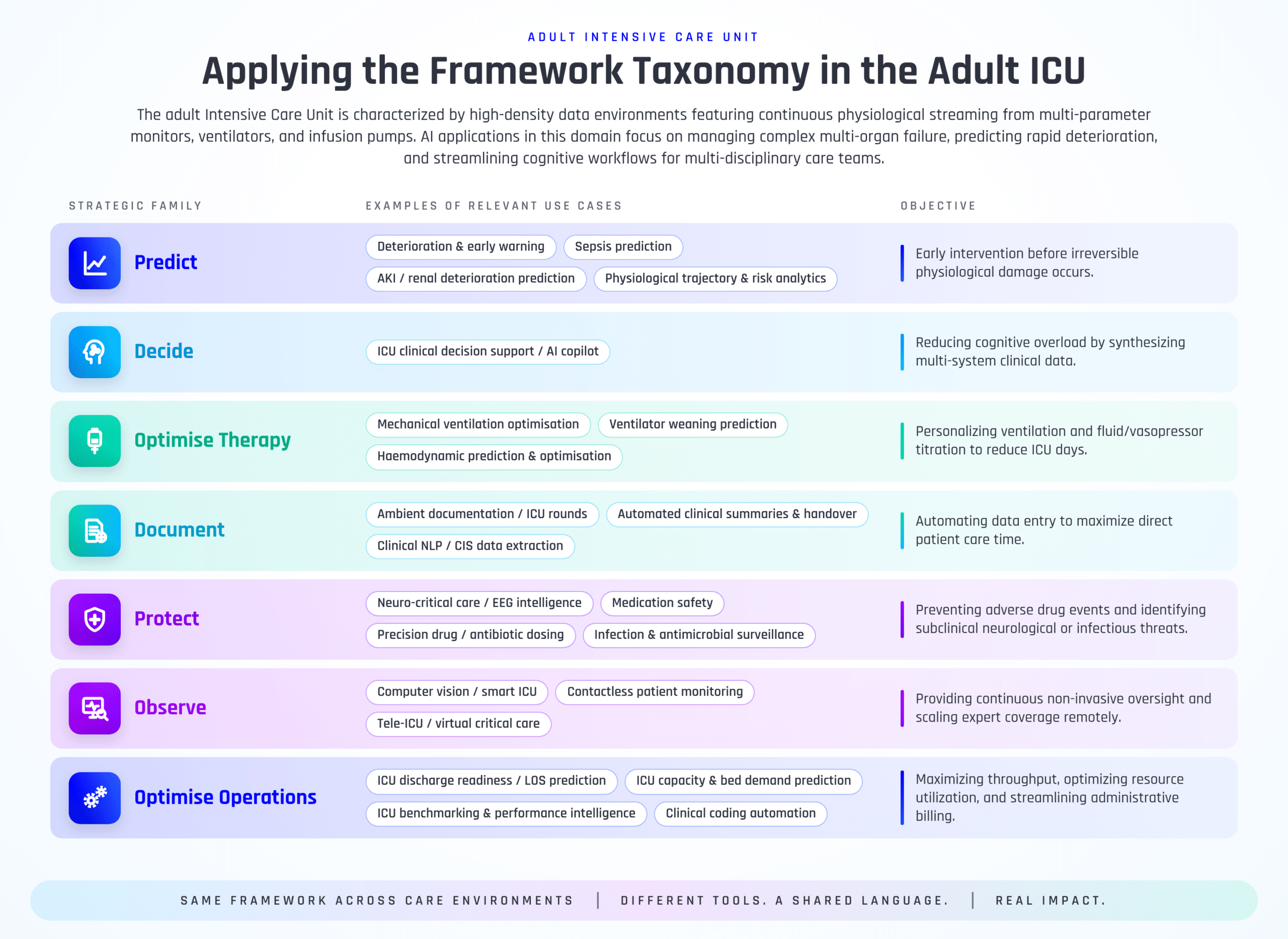
Applying the Framework Taxonomy in the Adult ICU
The adult Intensive Care Unit is characterized by high-density data environments featuring continuous physiological streaming from multi-parameter monitors, ventilators, and infusion pumps. AI applications in this domain focus on managing complex multi-organ failure, predicting rapid deterioration, and streamlining cognitive workflows for multi-disciplinary care teams.
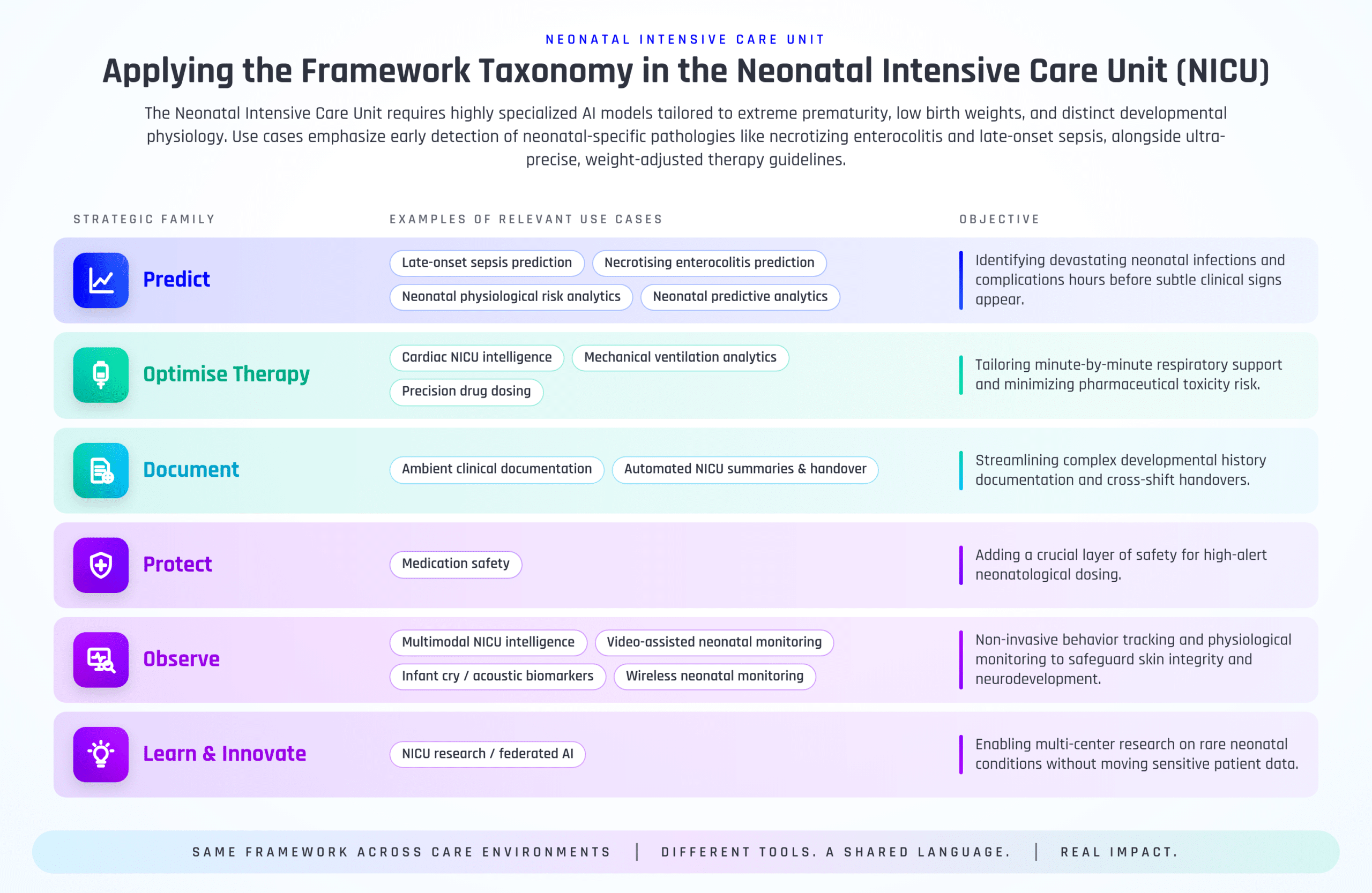
Applying the Framework Taxonomy in the Neonatal Intensive Care Unit (NICU)
The Neonatal Intensive Care Unit requires highly specialized AI models tailored to extreme prematurity, low birth weights, and distinct developmental physiology. Use cases emphasize early detection of neonatal-specific pathologies like necrotizing enterocolitis and late-onset sepsis, alongside ultra-precise, weight-adjusted therapy guidelines.
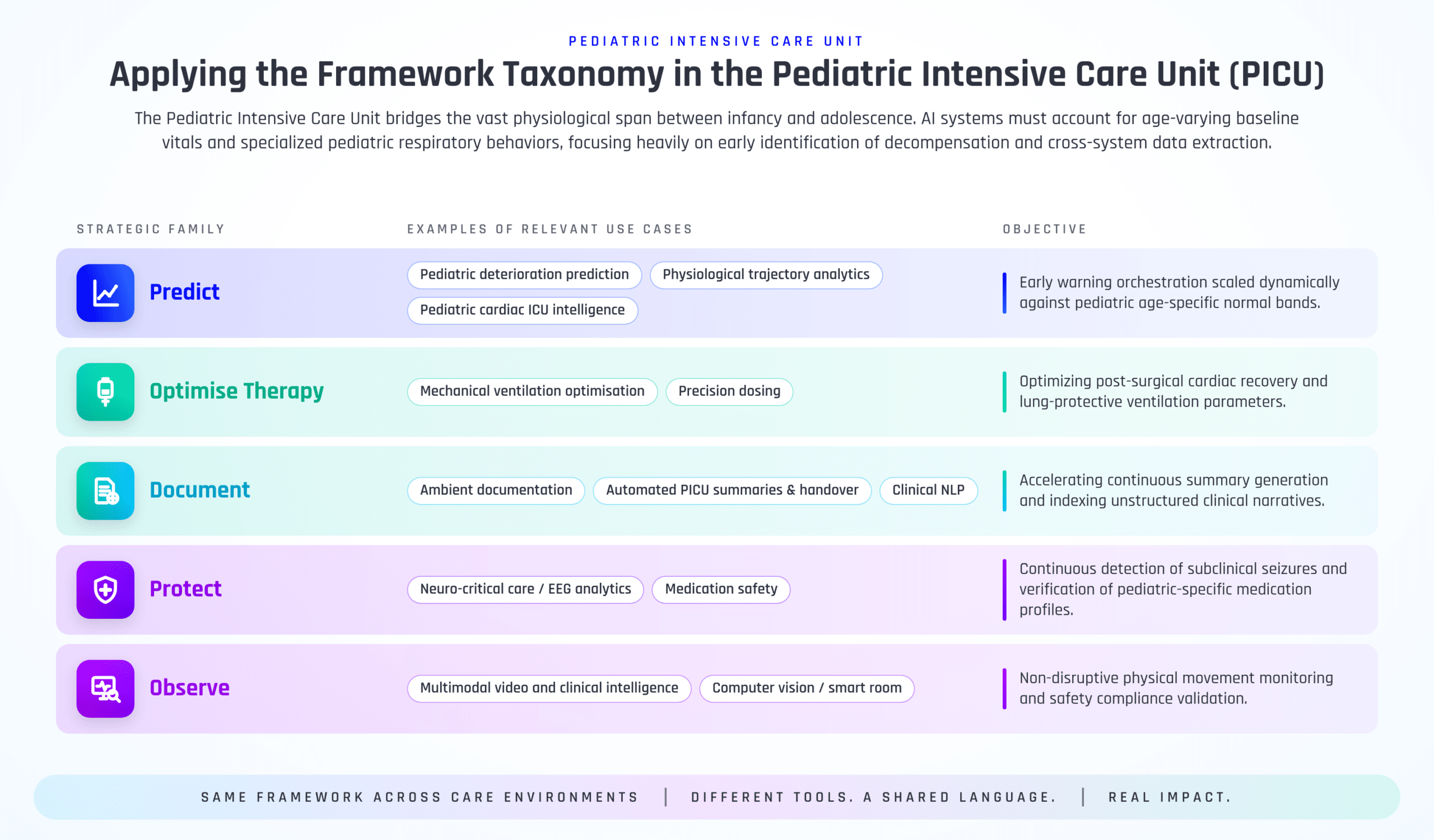
Applying the Framework Taxonomy in the Pediatric Intensive Care Unit (PICU)
The Pediatric Intensive Care Unit bridges the vast physiological span between infancy and adolescence. AI systems must account for age-varying baseline vitals and specialized pediatric respiratory behaviors, focusing heavily on early identification of decompensation and cross-system data extraction.
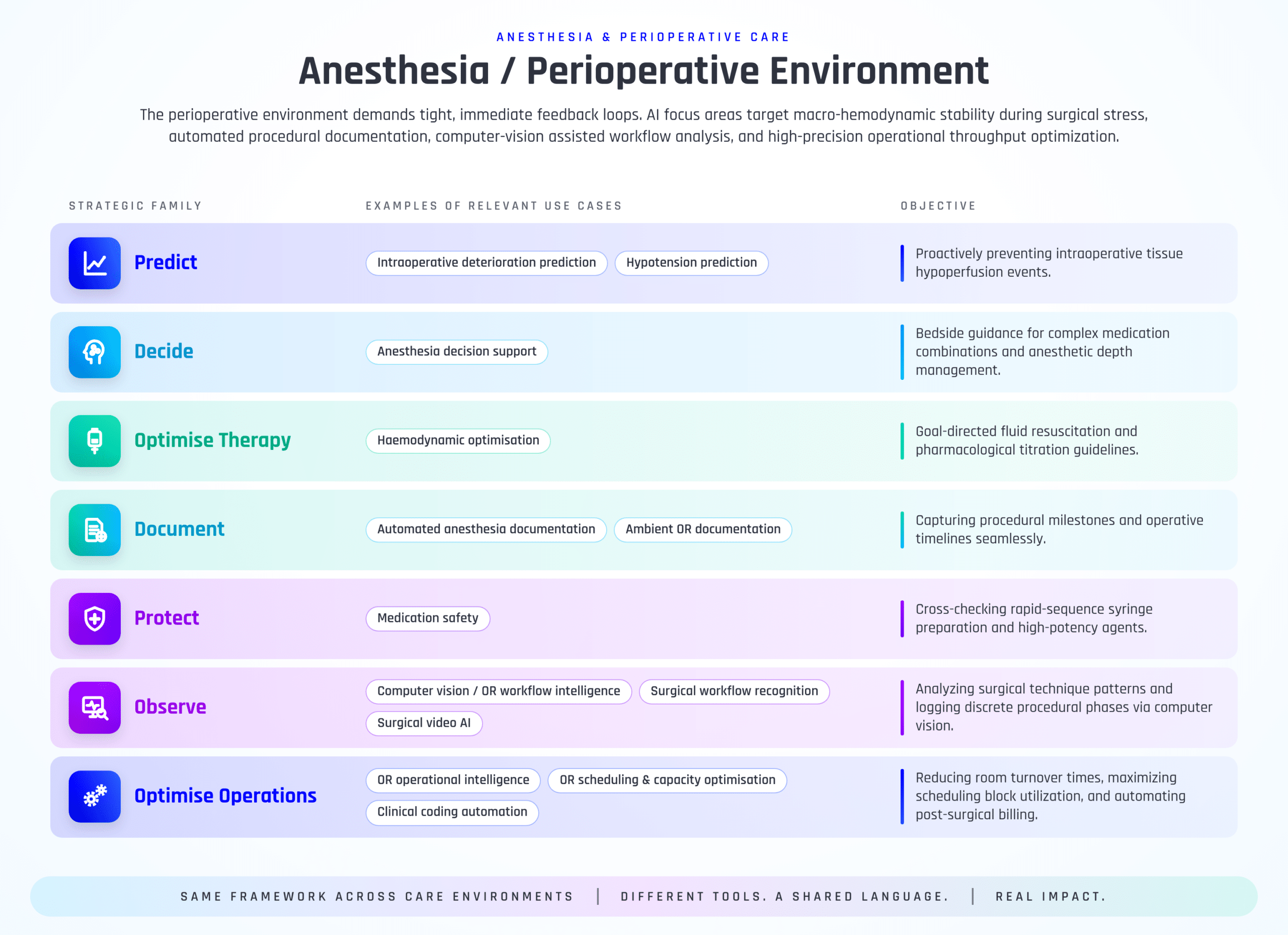
Anesthesia / Perioperative Environment
The perioperative environment demands tight, immediate feedback loops. AI focus areas target macro-hemodynamic stability during surgical stress, automated procedural documentation, computer-vision assisted workflow analysis, and high-precision operational throughput optimization.
Dr. Yakov Zhitomirsky Yakov has a clinical and academic nursing background with 20 years of experience across diverse healthcare settings, including the ICU and PACU. Yakov holds a Bachelor’s degree in Nursing Science, a Master’s degree in Public Health, and a Ph.D. in Information Science with a specialization in nursing informatics. Yakov is also active internationally in advancing the field of Nursing Informatics.
 Book a demo



 Login to Support Portal

