
 Support
 Contact us
 English


 Back to lobby

Dr. Yakov Zhitomirsky Sep 10, 2026
A framework for AI in critical care
Evaluating health tech in the critical care ecosystem means managing a relentless influx of high-stakes solutions: an AI sepsis alert on Monday, an ambient documentation platform on Tuesday, and an AI-powered computer vision monitoring system on Wednesday. All three are credible, and each comes with its own integrations, dashboards, alerts, and measures of success.
The critical care landscape suffers no shortage of promising artificial intelligence, yet it lacks an organizing mental framework to categorize these disparate initiatives. Without a structured perspective to ground each tool in clinical reality, health systems struggle to evaluate, sequence, and align these technologies into a cohesive operational strategy.
The evaluation problem
When those tools reach a hospital committee, they end up in the same spreadsheet, scored against the same criteria and competing for the same budget, even though they’re solving different problems. One is meant to change a clinical outcome and is judged on length of stay or mortality. Another gives a nurse time back and only shows its value within a quarter. Ranked on a single scale, the evaluation looks clean on paper, but that doesn’t make the comparison meaningful.
That mismatch is one reason AI pilots in critical care stall. Sometimes the technology works, but it’s been evaluated against expectations that belong to a different type of tool. When it doesn’t meet them, it becomes hard to tell whether the pilot failed or whether the organization was asking the wrong question.
When the market gets crowded, one natural response is to organize it by technology, with AI in one column, computer vision in another, and medical devices somewhere else. That’s useful for understanding how a system works, and much less useful for deciding what a hospital needs. Two products built on similar approaches may solve different clinical problems, while two products addressing the same problem may rely on different technologies.
The labels also keep changing. A roadmap built around today’s vocabulary has to be rewritten as that vocabulary evolves. The clinical needs are far more durable. Clinicians still need to recognize problems earlier, make better decisions, deliver therapy more precisely, spend less time documenting, reduce avoidable harm, maintain continuous oversight, run the unit effectively, and learn from what happened.
Start with the job
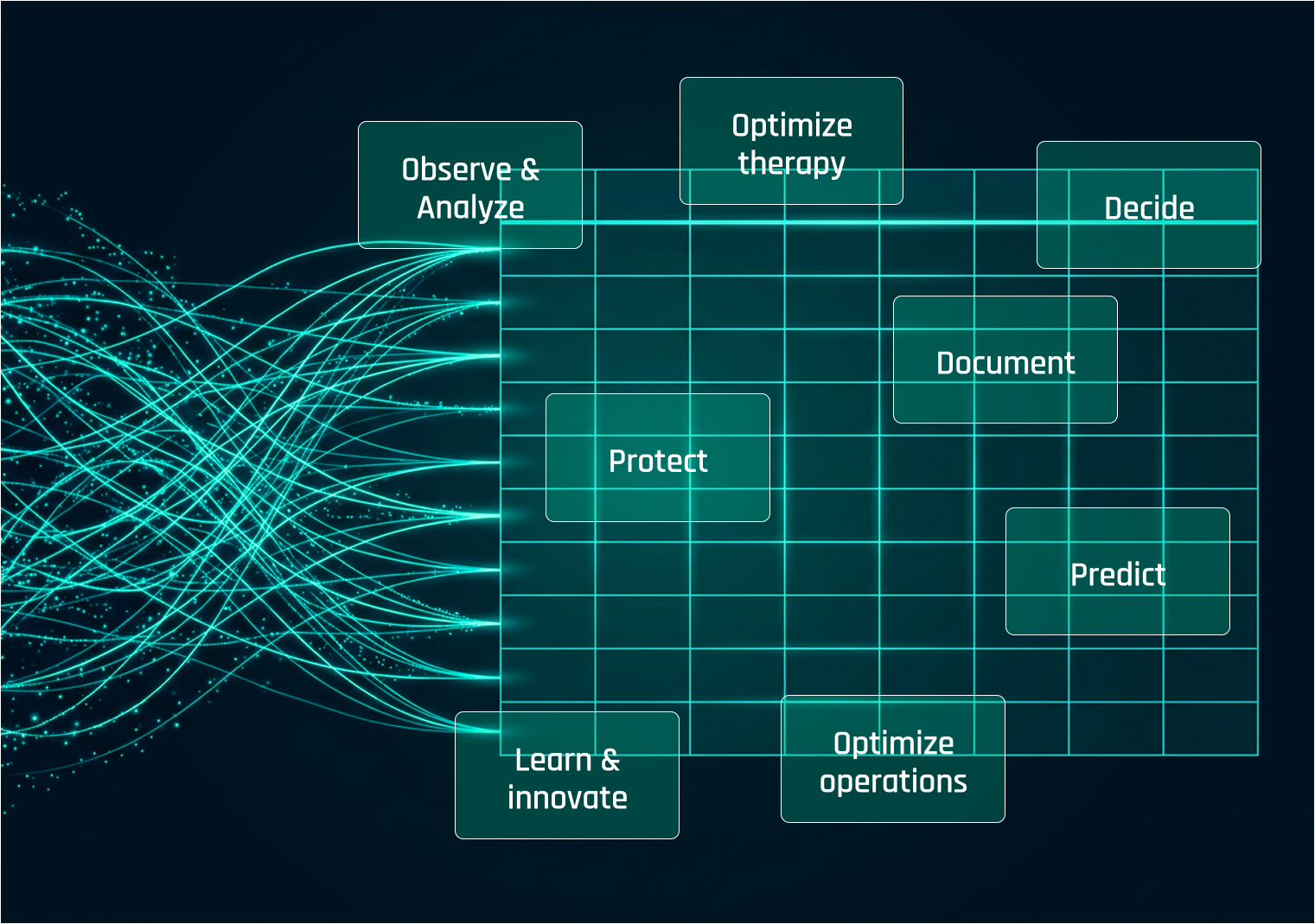
Instead of asking what a tool is made of, ask what job it’s doing in critical care. When applied consistently, that question sorts the landscape into eight use-case categories.
Predict: Recognize adverse clinical events before they manifest, using real-time physiological data. What you gain is time: the gap between the first meaningful signal and the point where intervention becomes urgent.
Decide: Support clinical reasoning through cognitive assistance and AI copilots. The goal is to reduce the cognitive burden of complex decisions made under heavy information load.
Optimize therapy: Fine-tune treatment already under way, through closed-loop or advisory systems for ventilation, hemodynamic stability, and precision dosing. The value here is precision.
Document: Reduce administrative burden using ambient intelligence, from documentation on rounds to automated handovers and clinical summaries. Clinical time goes back to the bedside.
Protect: Add safeguards around high-risk interventions through medication safety surveillance, antimicrobial stewardship, and smart alarm management. It narrows the margin for error where mistakes cost the most.
Observe and Analyze: Turn the care environment, diagnostic scans, and visual data into actionable intelligence using computer vision, imaging AI, and sensor systems. It extends oversight and provides objective, automated analysis of physical findings (such as wounds, lesions, or structural pathologies) to track progression and catch complications early.
Optimize operations: Improve efficiency and resource management through predictive models for length of stay, discharge readiness, bed demand, and scheduling. The value is capacity: using beds, staff, and time better.
Learn and innovate: Turn the experience of care into knowledge using privacy-preserving architectures such as federated learning. The aim is for what one unit learns to benefit the others.
These categories group technical capabilities by clinical and operational objective rather than by underlying technology, which brings the discussion back to a more useful question: what should be different because we have this?
The same job looks different across clinical domains
Even eight categories aren’t enough, because a category like Predict doesn’t mean the same thing everywhere.
In an adult ICU, prediction can mean the trajectory of multi-organ failure in a patient generating a continuous stream from monitors, ventilators, and pumps. In the NICU, it can mean late-onset sepsis or necrotizing enterocolitis in babies whose normal physiology is tied to gestational age. In the PICU, the baseline changes with age, so what’s meaningful for a fifteen-year-old tells you little about a toddler. In the operating room, the time horizon changes again, and intraoperative hypotension can demand a response measured in minutes rather than hours.
The intent is still prediction, but the clinical problem isn’t, and the model, the data, and the definition of success all change with it. A vendor with an excellent adult deterioration model doesn’t automatically have a useful neonatal one.
So the framework has two dimensions: the eight categories, and the clinical domains where they’re applied. Together they form a grid, set out in full at the end of this piece.
What the grid can help you see
Where your investment is concentrated: List what’s in use, what’s in pilot, and what’s under evaluation, and place each solution in a cell. Many organizations find that most of their activity sits in one or two categories, often Predict and increasingly Document, while other parts of the grid stay empty. That isn’t automatically a problem, since different environments have different priorities. What matters is whether the concentration reflects a deliberate decision rather than the order in which vendors make contact.
What evidence you should ask for: Different jobs call for different proof. For a prediction tool, lead time matters, but so does false-alarm burden, because an early warning has limited value if clinicians learn to ignore it. For a documentation tool, minutes saved matter, but so does sustained use once the novelty wears off. Protect is harder to evaluate, because success often consists of an event that didn’t occur, and process measures or near misses often tell you more than outcome measures alone. Without that distinction, a hospital can end up asking a good product to prove the wrong thing.
What these tools ask of clinicians: The grid also shows something that’s easy to miss when products are evaluated one at a time. Several categories draw on the same limited resource: clinician attention.
Predict interrupts. Protect interrupts. Decide interrupts more gently, but it still asks a clinician to notice something, process it, and decide what to do next. A unit can absorb only so many claims on attention in a shift before some of them stop landing, and alarm fatigue doesn’t distinguish between an interruption from a traditional monitor and one generated by a predictive model. So rather than asking how many tools you have in a category, ask how many claims on a clinician’s attention you’ve introduced, and whether anyone is tracking the cumulative effect.
A common vocabulary: “We’re strong in Predict, thin in Protect, and have very little activity in the NICU” is a sentence clinical, technical, and executive teams can all understand and act on. A list of eleven unrelated pilots isn’t.
Where the framework has limits
This isn’t an even grid, and there’s no reason it should be. Some categories are mature in adult intensive care and much less developed in neonatology or pediatrics. That empty space is informative, whether it reflects a difficult clinical problem, a smaller patient population, or an area the market hasn’t looked at yet.
The categories also don’t carry the same regulatory and governance implications. Tools that directly influence a clinical decision, including many within Predict, Decide, and Optimize therapy, are likely to face greater scrutiny than tools that summarize documentation or forecast bed demand. Two products can both create real value and still have different paths from evaluation to deployment. A technology-based classification obscures that, because tools built with similar methods can fall under different requirements once you look at what they do.
The framework isn’t a strategy, and it won’t tell a hospital what to buy or where to begin. What it can do is turn a long and growing list of technologies into a smaller set of questions about purpose, setting, and proof.
A closing thought
No hospital can evaluate every new tool simply because the technology is promising, and the number of tools is only going to grow. The organizations that get the most from this next wave won’t be the ones that adopt the most AI. They’ll be the ones that can explain what they’ve adopted, what job each tool is there to do, and what they expect to change as a result.
The technology and its terminology will keep evolving; the clinical jobs beneath them won’t. We’re offering this as a starting point rather than a finished answer, and we’d be interested to hear where it reflects what you’re seeing and where you think it needs to change.
Appendix: the framework in detail
Adult ICU
High-density data from monitors, ventilators, and infusion pumps, with a focus on multi-organ failure, rapid deterioration, and the cognitive demands on multidisciplinary teams.
Predict: deterioration and early warning, sepsis, AKI and renal deterioration, physiological trajectory, and risk analytics.
Decide: ICU clinical decision support and AI copilots.
Optimize therapy: ventilation optimization, weaning prediction, hemodynamic prediction, and optimization.
Document: ambient documentation on rounds, automated summaries and handover, clinical NLP, and data extraction.
Protect: neurocritical care and EEG intelligence, medication safety, precision antibiotic dosing, infection and antimicrobial surveillance.
Observe: computer vision and smart ICU, contactless monitoring, tele-ICU, and virtual critical care.
Optimize operations: discharge readiness and length-of-stay prediction, capacity and bed demand, benchmarking, coding automation.
NICU
Models built for extreme prematurity, low birth weight, and distinct developmental physiology, with attention to neonatal-specific pathologies and weight-adjusted therapy.
Predict: late-onset sepsis, necrotizing enterocolitis, neonatal physiological risk analytics.
Optimize therapy: cardiac NICU intelligence, ventilation analytics, and precision drug dosing.
Document: ambient clinical documentation, automated summaries, and handover.
Protect: medication safety for high-alert neonatal dosing.
Observe: multimodal NICU intelligence, video-assisted monitoring, infant cry and acoustic biomarkers, wireless monitoring.
Learn and innovate: NICU research and federated AI for rare conditions.
PICU
A setting that spans infancy through adolescence where models must account for age-dependent baseline vital signs and pediatric respiratory behavior.
Predict: pediatric deterioration, physiological trajectory analytics, pediatric cardiac ICU intelligence.
Optimize therapy: ventilation optimization, precision dosing.
Document: ambient documentation, automated summaries and handover, clinical NLP.
Protect: neurocritical care and EEG analytics, medication safety.
Observe: multimodal video and clinical intelligence, computer vision, and smart room.
Anesthesia and the OR
A perioperative setting demanding tight feedback loops around hemodynamic stability, procedural documentation, and operational throughput.
Predict: intraoperative deterioration, hypotension prediction.
Decide: anesthesia decision support.
Optimize therapy: hemodynamic optimization.
Document: automated anesthesia documentation, ambient OR documentation.
Protect: medication safety for rapid-sequence preparation and high-potency agents.
Observe: OR workflow intelligence, surgical workflow recognition, surgical video AI.
Optimize operations: OR operational intelligence, scheduling and capacity optimization, coding automation.
Dr. Yakov Zhitomirsky Yakov has a clinical and academic nursing background with 20 years of experience across diverse healthcare settings, including the ICU and PACU. Yakov holds a Bachelor’s degree in Nursing Science, a Master’s degree in Public Health, and a Ph.D. in Information Science with a specialization in nursing informatics. Yakov is also active internationally in advancing the field of Nursing Informatics.
 Book a demo



 Login to Support Portal
